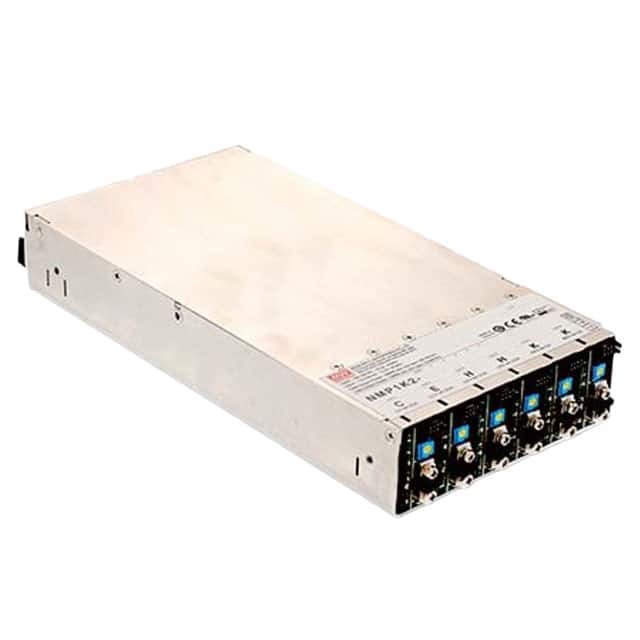
For the MEAN WELL NMP1K2-HHKEKH-00 AC/DC converter, a robust reliability and quality program begins with understanding its inherent qualifications. This 1200W, multi-output industrial power supply is designed to meet several critical international standards. Key reliability benchmarks include safety certifications like UL/EN/IEC 62368-1 for IT and audio/video equipment, which validates design integrity against electrical, fire, and mechanical hazards. For industrial environments, EN 62477-1 (OVC III) certification for power electronic systems is particularly relevant, ensuring robustness for higher-power applications. Furthermore, compliance with EMC standards EN 55032/55035 and FCC Part 15 indicates design maturity that minimizes noise-related failures. While not a reliability standard per se, the 80 PLUS Platinum efficiency rating signals the use of high-quality components and advanced topology, which reduces thermal stress—a primary driver of long-term failure.
Accelerated life testing (ALT) is fundamental to predicting this converter's lifespan under normal operating conditions. Manufacturers subject units to stresses like elevated temperature (often 105-125°C on critical capacitors), elevated input voltage, and cyclic loading beyond specification limits. The Arrhenius model is commonly used for temperature acceleration, where a 10°C increase can theoretically double the failure rate. Results from ALT, such as a demonstrated 1000-hour test at 125°C, allow engineers to extrapolate a field lifespan of tens or hundreds of thousands of hours. For this MEAN WELL model, special attention in ALT would be paid to the primary electrolytic capacitors, power MOSFETs, and the output rectifiers, as these are typically the life-limiting components. Successful ALT provides statistical confidence in the base failure rate before deployment.
Quantifying reliability involves metrics like Failure in Time (FIT) rates and Mean Time Between Failures (MTBF). The FIT rate (failures per 10^9 device-hours) for industrial-grade power supplies like this one is often derived from handbook standards such as MIL-HDBK-217F, Telcordia SR-332, or Siemens SN 29500. A typical MTBF figure for a quality 1200W unit might be quoted at 100,000 hours or more, but it is crucial to understand the conditions (e.g., 25°C ambient, 50% load) and the calculation standard used. These are statistical predictions, not guarantees. The actual field MTBF is heavily influenced by application factors, with operating temperature being the most critical variable. Derating the load to 70-80% of maximum and ensuring adequate cooling can dramatically improve real-world MTBF, often by a factor of two or more.
Environmental Stress Screening (ESS) and burn-in are proactive quality filters. For high-power converters in critical applications, a thermal cycle burn-in is highly effective. This involves powering the unit at full load while cycling the ambient temperature between specified high and low limits (e.g., 0°C to 70°C) to precipitate early-life "infant mortality" failures in solder joints and components. A simpler steady-state burn-in at elevated temperature (e.g., 45-50°C) and 100% load for 24-72 hours is a common best practice for incoming inspection of critical lots. This process weeds out units with latent defects that would fail early in service, ensuring the deployed population enters the stable, random failure period of the bathtub curve.
Counterfeit detection for this component requires a multi-faceted approach. MEAN WELL is a frequent target for forgery. Incoming inspection must include visual scrutiny of labeling, logos, font, and finish against a known-good sample. Internally, check for consistency in component branding, solder quality, and conformal coating. Electrically, counterfeit units often fail to meet specification on efficiency, ripple/noise, or hold-up time. Perform key parametric tests at minimum, nominal, and maximum input voltage under load. The most definitive method is to purchase directly from authorized distributors and verify the supply chain pedigree. MEAN WELL USA Inc. may also provide authentication services or unique identifiers for high-volume procurement.
Incoming inspection best practices extend beyond counterfeit detection. A comprehensive plan should include Acceptable Quality Level (AQL) sampling per ANSI/ASQ Z1.4 for visual and dimensional checks. Electrically, a sample from each lot should undergo full parametric validation: input surge test, efficiency measurement, line/load regulation, ripple & noise verification, and functional tests of the control signals (e.g., remote on/off, power good). X-ray inspection can be used on a sample basis to verify internal solder joint integrity and transformer construction without destructive disassembly.
Proper storage and handling are essential to preserve reliability. This converter should be stored in a climate-controlled environment (ideally <40°C and <70% relative humidity), preferably in its original moisture barrier bag if the desiccant is intact. Adhere to IPC/JEDEC J-STD-033 standards for moisture-sensitive devices, as the internal PCB assembly is likely rated for moisture sensitivity (MSL). Avoid stacking heavy items on the units. During handling, use ESD precautions. Prior to powering after extended storage, a gradual baking process may be necessary to prevent popcorning of moisture-laden components.
End-of-life (EOL) management and obsolescence planning are strategic necessities. Upon receiving an EOL notice from MEAN WELL, immediately perform a last-time buy (LTB) analysis based on the product's forecasted service life. For this high-wattage platform, also identify and qualify a form-fit-function (FFF) replacement or a second source well in advance. Maintain an accurate bill of materials (BOM) and lifecycle status for all critical sub-components (e.g., ICs, transformers) to anticipate cascading obsolescence. For products with long field-life commitments, consider a controlled spares inventory program with periodic rotation and testing to ensure spare units remain functional when needed decades later.