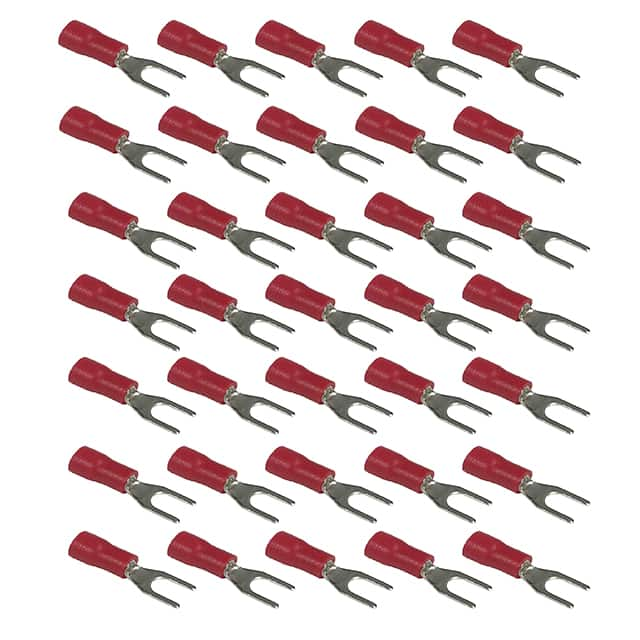
In the realm of electrical interconnection and wire termination, insulated fork terminals represent a fundamental and critical hardware category. These components serve as the reliable interface between a stranded or solid-core wire and a screw-type terminal block or binding post. Their primary role is to create a secure, low-resistance, and mechanically robust connection that prevents wire fraying, ensures consistent electrical contact, and facilitates safe installation and maintenance. The specific component in focus—the Remington Industries SVS1.25-3.5-100—is a quintessential example: a PVC-insulated, vinyl-crimped fork terminal with a #8 stud hole (0.250" / 6.35mm) and a wire range of 14-16 AWG, supplied in bulk quantities.
When selecting any insulated fork terminal, several key parameters dictate suitability and performance. The wire gauge range is paramount; the terminal must match the conductor size precisely to ensure a proper crimp. The stud or screw hole size (e.g., #8, #10, 1/4") must correspond to the fastener on the terminal block. The insulation material, typically PVC or nylon, dictates temperature rating and chemical resistance. The terminal barrel material, usually electrolytic copper (often tin-plated for corrosion resistance), determines current-carrying capacity and long-term conductivity. Finally, the crimping style—whether insulated (as with this vinyl sleeve) or non-insulated—affects the tooling required and provides additional strain relief and touch protection.
Comparing the Remington SVS1.25-3.5-100 to alternatives reveals clear trade-offs. Against non-insulated fork terminals, it offers superior safety and strain relief but at a slightly higher material cost. Compared to ring terminals, fork terminals allow for quicker installation and removal without completely removing the screw, ideal for maintenance or testing points, though rings provide a marginally more secure connection under extreme vibration. Versus fully insulated (nylon) or heat-shrink terminals, this PVC-insulated version is a cost-effective workhorse for general-purpose applications but may have a lower temperature rating and less robust environmental sealing. In terms of brand alternatives, manufacturers like TE Connectivity, Molex, or Panduit offer equivalents, often at a premium price with potentially tighter manufacturing tolerances, while generic imports may compete on cost but with variable quality. The Remington product positions itself as a reliable, value-oriented option with strong availability through distributors.
Industry trends are shaping this mature component category in several ways. There is a growing emphasis on supply chain resilience, driving demand for components with second-source availability. The rise of automation in wire harness assembly is increasing the need for terminals with consistent dimensions for reliable automated crimping. Furthermore, while basic PVC remains dominant, there is incremental growth in demand for higher-temperature and halogen-free insulation materials to meet stricter environmental and safety regulations in certain sectors. The trend towards miniaturization also pressures terminal manufacturers to maintain performance in smaller form factors, though this is less relevant for this particular power-oriented size.
Choosing this specific Remington Industries terminal is advisable in several common procurement scenarios. It is an excellent choice for high-volume, cost-sensitive projects where reliable general-purpose performance is required, such as in industrial control panels, appliance wiring, or automotive aftermarket installations. Its 100-piece bulk packaging is ideal for production lines or maintenance shops. Select this component when you need the service loop convenience of a fork terminal for equipment that may require periodic wiring disconnection, and when the operating environment is within standard commercial/industrial temperature and humidity ranges. It is also a prudent selection when seeking a balance between the assured quality of a known domestic brand (Remington) and the cost pressures that preclude premium connector manufacturers.
From a procurement standpoint, several considerations are vital. For this SKU, lead times are typically short as it is a standard, high-volume item commonly held in distributor stock, but verification is always recommended during supply chain disruptions. Its lifecycle status is almost certainly active and mature, with no anticipated obsolescence, given the universal nature of the design. Second-source options are plentiful; procurement teams should identify equivalents by matching the critical parameters: insulated fork terminal, #8 stud hole, 14-16 AWG range, and PVC insulation. Cross-referencing to part numbers from TE Connectivity (e.g., series 34106) or other major suppliers provides supply chain flexibility. Always validate with a sample and crimp tool test before large-scale commitment, as subtle differences in barrel design or insulation thickness can affect performance in automated or manual crimping processes.